
From Investment to Impact: Building Grant-Writing Capacity for NJ Community-Based Organizations

Across New Jersey, community-based organizations are doing the work that keeps residents fed, housed, resourced, and connected, often with a fraction of the staff and resources needed to sustain it. As needs grow, so does the pressure to expand services and secure the funding to do so, which often depends on grant writing, a specialized, time-intensive skill few smaller organizations have the staff to dedicate to it. The result is a widening gap between demand and resources. As agencies navigate ongoing shifts in federal funding, community organizations are absorbing the pressure of growing need while facing greater uncertainty about the resources available to meet it.
To close that gap, the Rutgers Equity Alliance for Community Health (REACH) funded Cara Cuite, PhD, Associate Director of Community and Student Engagement at the New Jersey Institute for Food, Nutrition, and Health and Associate Professor and Extension Specialist in the Department of Human Ecology, to partner with the New Jersey Food Democracy Collaborative (NJFDC) on a project to build grant-writing capacity for organizations in Camden, New Brunswick, and Newark.
To better understand the challenges facing community organizations and identify the most effective ways to support them, the project began with a qualitative needs assessment. Focus groups in Camden, New Brunswick, and Newark brought together 15 representatives from local organizations to share their needs and experiences. The same themes surfaced in each community — organizations struggled to find funding opportunities that fit their mission, had no dedicated staff time to seek and write grants, lacked the data to back up their proposals, found budgeting and indirect costs confusing, and needed help building the kind of partnerships funders increasingly expect.

The grantees responded by partnering with a team of three professional grant writers. Anthony Capece and Asia Marche co-designed a 10-module course covering the full grant lifecycle, which includes optional videos, activities, and additional resources. Capece, Marche, and Catherine Ruff also provided individualized grant-writing consulting. Each consulting engagement started with an intake conversation about the organization's programs and funding history. From there, the work depended on how ready the organization was. Some moved straight into prospect research and proposal narratives, while others needed to build the basics first, like a grant calendar or a tracking system.
The course launched in August 2025, but that fall, most of the organizations it served were consumed by the November 2025 disruption to SNAP benefits, pulling many into emergency response mode with little room for grant planning. By spring 2026, an online survey and interviews with community partners revealed a second problem: of the 113 people who'd enrolled, only 10 earned the digital badge awarded upon course completion. Feedback revealed it was too long and challenging to navigate, given the limited time available to the community groups. “The people who need these courses are time-constrained,” said Yvette Ng, NJFDC project manager.
Dr. Cuite’s team listened, simplified the Canvas course, and built an additional website with most of the same content, so organizations can jump straight to the content they need without registering or navigating the online course system. Both run on Rutgers' infrastructure, including Rutgers digital badging system and video content produced with Rutgers' Office of Continuing Professional Education (OCPE). At the same time, the team ramped up outreach across the three cities.
Between September 2025 and June 2026, the consultants delivered more than 217 hours of one-on-one support to clients from 20 organizations across all three target cities. Clients submitted 33 grant applications to 27 different funders; ten were awarded, totaling $655,000, with 15 still pending. For every dollar REACH invested in the project, clients have already secured about $3.30 in grant funding, a figure that will continue to climb as pending applications are decided.
Ng emphasized that the consulting model's strength was its flexibility. "We worked with a number of different organizations and people with a wide range of expertise, so it was important that we tailored our consulting to their specific needs," she said. "Some needed confidence or support on the foundational knowledge. Others needed to find funding opportunities, or needed more guidance on budgeting." One Newark participant, new to grant writing, described what that consulting support meant to her: "I felt very discouraged, and [the consultant] gave me a lot of encouragement and motivation... She understood me in a way that helped me feel better about the process."
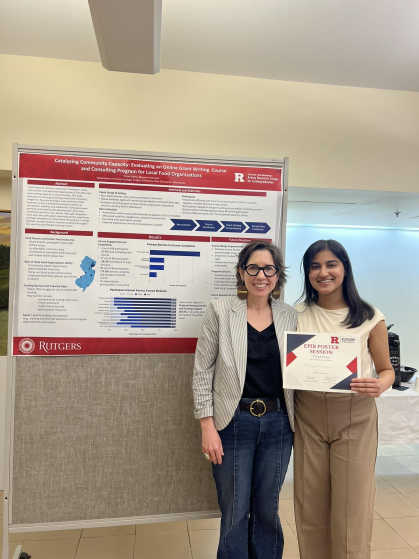
The project also created hands-on research and professional experience for Rutgers students. Tirzah Johns, a Class of 2028 Public Health major with a minor in Public Policy, presented research from the project at the Human Ecology Student Poster Symposium, where her work received the best poster award at the Aresty Student Poster Session, part of a broader student research effort that included Annika Noel and Will Clarke. Lexi Tassone, a 2026 SEBS graduate, spent multiple summers working with Cuite and led the development of the new website.
The course and website are both free, providing grant-writing resources in multiple formats to organizations well beyond the project's original three cities. Enrollment in the online course has already drawn participants from across the country.
For Asia Marche, curriculum developer, grantwriting instructor, and nonprofit consultant, the resources represent an opportunity to strengthen organizations beyond any single grant award.
“I believe access to information is a form of empowerment,” Marche said. “When we equip community leaders with the tools to navigate funding systems, we're not simply helping them write stronger proposals; we're strengthening their ability to build sustainable solutions to the challenges their communities face.”
Looking ahead, Marche hopes the website will evolve into a resource that supports nonprofit leaders at every stage of organizational development, expanding beyond grant-writing fundamentals to include strategic planning, alternative revenue generation, impact measurement, and organizational sustainability. “If this resource helps even one grassroots organization move from operating in survival mode to planning strategically for its future, then we're creating an impact that extends far beyond the classroom,” she said.
"It's not just about the funding; it's about pairing that funding with real grant-writing skill development and support," Cuite said. "That's how we extend the university's reach to community-based organizations of every size, many of them very small, all of them touching the lives of the people they serve."
When we invest in the capacity of organizations already working in their communities, the investment multiplies. Here, the initial funding helped create not only new resources but also the support and infrastructure that organizations can continue to use to pursue funding and expand their impact long after the grant cycle ends.
Explore Community Grant Writing Resources and share it with any organization that could put it to use.
NJFDC and REACH will further spotlight the project at the NJ State of the Food System Summit on December 10, 2026, in New Brunswick, which is expected to draw more than 250 food-system stakeholders from across the state.


