
Centering Community Voices in Research

How Photovoice Turns Experience into Data

The purpose of photovoice, according to Pamela Rothpletz-Puglia, EdD, RDN, is to learn from people who experience the problem you’re studying. And what tool could be more apt for a study funded by REACH, whose primary purpose is to support thoughtful, participatory research in communities where social determinants of health are at the root of health inequity?
Rothpletz-Puglia—a professor in the Department of Interdisciplinary Studies at Rutgers School of Health Professions—has long been a practitioner of qualitative and mixed-methods research, and is a firm believer in participatory problem-solving approaches to health. “When families co-produce solutions to health issues that fit the context of their lives, those solutions are far more likely to be successful,” she asserts, speaking from 20 years of experience as a registered dietitian practicing in Newark.
Rothpletz-Puglia’s REACH project, Dismantling the “Kids’ Food” Archetype, took just such an approach to the issue of ultra-processed kids’ food, which is heavily marketed in cities with low-income and minority residents. “This targeted marketing encourages diets with limited variety, which creates resistance to new food, ultimately increasing lifetime risks of obesity and chronic disease,” says Rothpletz-Puglia. Her project, an assessment of the children’s food culture and environment in Newark, was informed by the participation of local mothers of young children, who used cameras (provided by the study) to document the environment.

When we look at the epidemic of type 2 diabetes we’re seeing in children, it’s often because their families abandon the foods that they came to this country eating, because of price, pressures, convenience, and so on.
Dr. Denise Rodgers
The Leaguers, Inc., a local social services agency serving the Newark community, and longtime partner of Dr. Rothpletz-Puglia, worked with the team to recruit 25 Newark mothers in the multi-phase study employing photovoice. “They created the data by taking the photos,” explains Rothpletz-Puglia.
The group of mothers took an initial set of photos and participated in focus-group discussions afterward to talk about why they took each photo. These rich conversations not only helped the study team devise an appropriate nutritional education intervention, but raised critical awareness among the participants. The shift became evident in the discussions that followed the second group of photos.

“The photos were similar, but the reasons they took them were different,” says Rothpletz-Puglia, who was struck by the change. “Mothers became critically conscious and critically aware of the environment, noticing things like advertising.”
“Some conducted their own experiments,” Rothpletz-Puglia continued. “One mother used a wheelchair to simulate the [supermarket] experience from a four-year-old’s perspective.” This mother observed that candy is placed on low shelves, and character-driven, sugary products are put in direct view of the smallest consumers.
Others took photos while driving down the street to show how they might encounter seven or eight fast-food places in a row before encountering one healthy option.
“‘Why is that?’ they asked,” reports Rothpletz-Puglia. “That insight—that’s how you start creating movement within communities.”
Rothpletz-Puglia and her team, which included The Leaguers’ Arthur Nabi, MBA, RN, and Veronica Jones, PhD, MPH, CHES (also a REACH grantee for a separate project), published the results of their research in two peer-reviewed articles: one appearing in the CDC’s Preventing Chronic Disease in April 2026; the other in the Journal of Nutrition Education and Behavior in May 2026.
The focus groups doubled as a space for connection. Throughout their regular meetings, the mothers shared openly about the struggles of feeding their families, and began supporting one another through an exchange of resources, recipes, and solutions. What began as research, evolved into learning and mutual support.
The interesting part is to see how this gets translated. What does it mean in terms of what parents offer their children? To what extent will people come together and advocate for better choices?
Pamela Rothpletz-Puglia
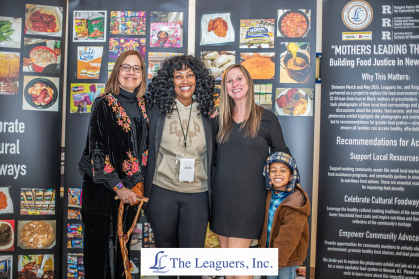
Meanwhile, Rothpletz-Puglia continues her work in community-engaged research beyond the REACH project. In addition to continued involvement with The Leaguers, she is currently working with the Focus Hispanic Center for Community Development, in a project led by Jose Centeno, PhD, CCC-SLP, who is also a faculty member in the School of Health Professions.
Centeno and team are delivering interprofessional brain health education (speech-language pathology, occupational therapy, physical therapy, and nutrition) to seniors served at the Focus Center this summer. “We co-produce the education with the service recipients; they tell us what they want,” says Rothpletz-Puglia. “We have faculty representation from all disciplines, and students within those disciplines deliver the education. It’s an exciting partnership.”


